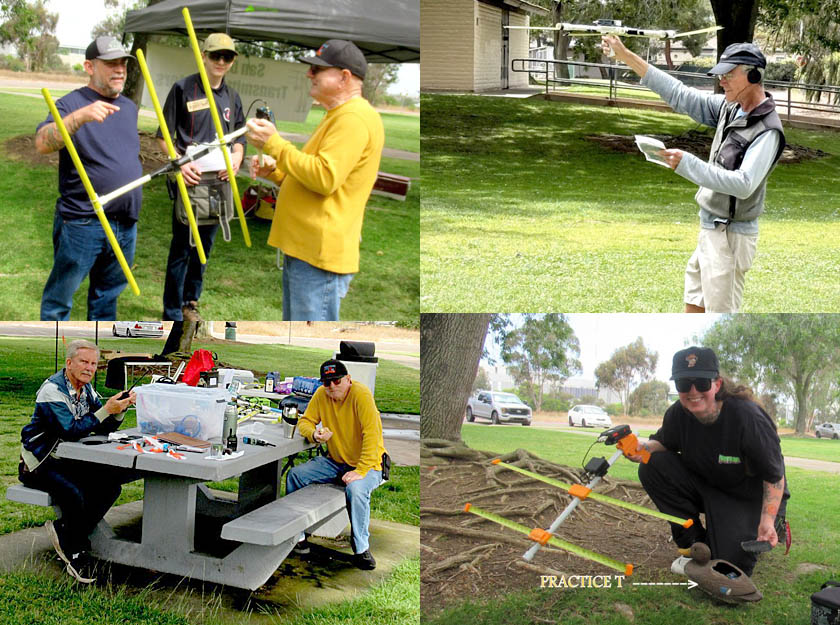
Results and photos from the session in San Diego on May 16, 2026 will be available here soon.
|
|
This year’s annual on-foot transmitter hunt and barbecue was held at Kearny Mesa Community Park in San Diego. We had excellent weather for a walking hunt with 37 in attendance, 26 being hams. Nineteen hams and eleven associated family members tackled the very short and flat course, attempting to locate the five hidden T’s in the park. We had several new hams who had just received their licenses within the last few months and six first-time hunters. Cat Donner KM4FAB received her license on May first. The barbecue got underway about 1:45 as most hunters were back by then. (It was a really short course!) We were missing some regular local hunters. We really missed Cliff Steagall N5BXE, who recently became a silent key.
Joe Loughlin KE6PHB, Robert Dexter N9SCD and I arrived early and began setting things up. The concrete tables were soaked due to sprinklers sometime in the night. It took twenty minutes to get them all cleaned and dried off so we could synchronize the five transmitters for the hunt. Robert held down the doughnuts and other assorted equipment while Joe and I set out the transmitters and punches. We finished about 9:30 and headed back to get ready for the hunt. There was a ham there who helped us for a while and was interested in hunting, but just disappeared while we were setting up. His name was Jerome, we did not get his call sign so sorry we cannot othweise acknowledge his presence. There was a real rush between 9:45 and 10:30 due to several people showing up who had heard about this event through one club or another or one net or another, so we had a backup trying to get the hunters that were familiar with the hunt started and then teach the newbies the technique of using sniffers on the two practice T’s we had set up. Joe and Robert spent some quality time with them to make sure they could accurately locate a hidden T. Once things got going and many hunters were out on the course, it settled down enough to get some of the new hams out on the course with loaner equipment. Some of the returning hunters helped by giving out some instructions and loaning their equipment to the new folks.
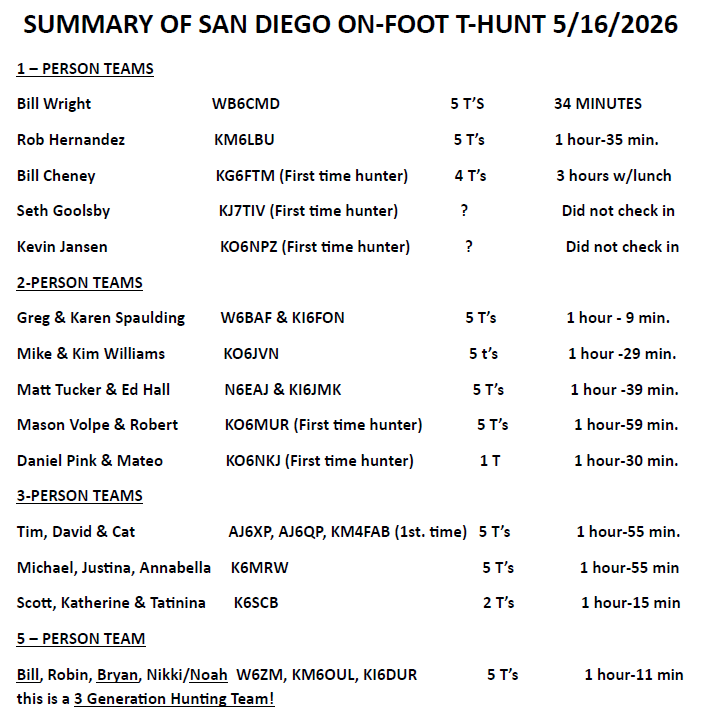
The results:
We also had several hams drop by to say hello, observe, or test out some personal equipment while our transmitters were up. Those included Noel Encarnacion AG6KA, Bill Calderwood K1CT and Danny Briggs KD6OKR. The BBQ went well except that we almost ran out of hamburgers, not anticipating such a large crowd. We did however, have adequate hot dogs as back up. The clean-up crew was great (Rob Hernandez KM6LBU and Danny Briggs KD6OKR) in helping to get everything packed up and over to our vehicles. Ed Hall KI6JMK and Matt Tucker N6EAJ were a great help by volunteering to go pick up all the hidden T’s, saving us quite a bit of time. Thank you to all those that assisted and we hope to see everyone next year!
Joe Corones N6SZO

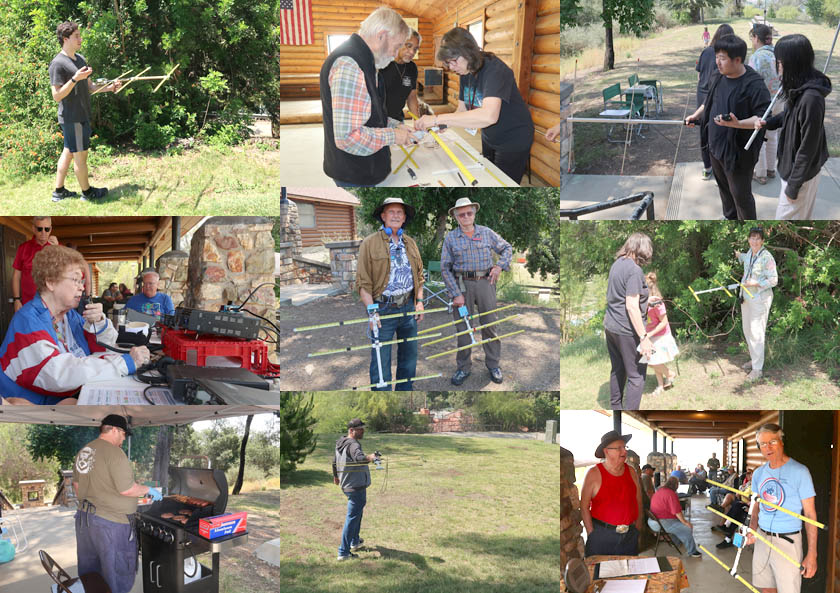
The weather was excellent for the Fullerton Radio Club's 29th annual Antennas In The Park and barbecue event. Compared to a high of 98 degrees last year, the thermometer only reached 81 this time. Marvin Johnston KE6HTS arrived early from Santa Barbara with his measuring-tape two-meter antenna and offset attenuator kits. Three two-meter practice transmitters on separate frequencies called out to encourage newcomers to try to find them. Yvette Weilacker KD6ESZ, Ellen Cole KN6YVG, Greg Hastings KO6DOM and Blaise Prymmer were among the newcomers who tracked them down.
The advanced course followed the classic radio-orienteering format. There were five two-meter transmitters, transmitting one after another on the same frequency for sixty seconds each in numbered sequence and then repeating. They awaited the hunters near the trails in the far reaches of the park. I wanted to time everyone who went out on that course but I wasn't successful. As usual, champion William Wright WB6CMD set the pace. Joe Corones N6SZO and Joe Loughlin KE6PHB came up from San Diego to try Orange County style ARDF and to promote the on-foot hunt that they would put on the following weekend. Jenna Canillis WWØMAN and Tianxing Guo KO6NKL independently found the practice transmitters and then tried the main course, each finding two transmitters.
     TWO-METER COURSE RESULTS -- 5 FOXES
      Name and call            Time H:MM:SS    Foxes

     William Wright WB6CMD        0:34:00        5

     Michael Hart KC6MEH          1:40:00        5

     Joe Corones N6SZO            1:59:00        4
        with Joe Loughlin KE6PHB

     Jenna Canillis WWØMAN           ?           2

     Tianxing Guo KO6NKL             ?           2
Band conditions did not favor the two HF stations on 40 and 20 meters, but the operators had fun trying to make contacts.
Thanks to FRC president Ray Rounds K6RAX for for procuring all of the food and Bob Houghton AD6QF for lots of ice-cold bottled water. As usual, our master of the grill was Albert Solomon AG6OF. Gene Thorpe KB6CMO made it possible to enjoy the Izaac Walton League cabin.
Joe Moell KØOV
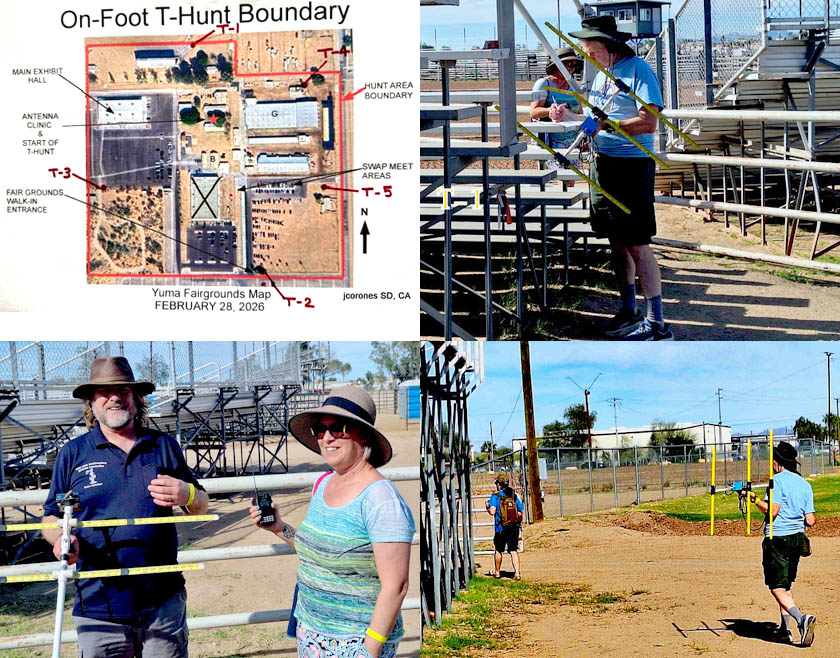
What looked promising this year turned into a very low key and hot event. Joe Loughlin KE6PHB had planned to ride out to Yuma with Robert Dexter N9SCD and me, but he had to abort at the last minute. Marvin Johnston KE6HTS, who was bringing the antenna kits from Santa Barbara, had a car breakdown in the Los Angeles area and also had to abort, leaving Robert and me to entertain any T-Hunt "groupies" on Saturday afternoon when the Antenna Clinic and T-Hunt were scheduled to occur.
There was confusion because the printed schedule of talks/events did not match the website schedule locations. Finally, we determined that our location was to be in the 4-H building. We unloaded our equipment into a dimly lit room with eight tables and chairs. Only five other people signed up for the hunt. Two were San Diego T-Hunters, Greg Gibbs KI6RXX and Dennis Baca KD6TUJ. Michael Hart KC6MEH came from Chatsworth. The other two were Mike Carter N7GNX and Dan Conway NØLNT, who had been in contact with Marvin regarding the tape measure beam antennas.
Greg and Dennis were tasked with holding down the fort while Robert and I went out to hide the transmitters. See photo of map showing location of hidden T's for this hunt. Around 2:00 PM we went through our PowerPoint presentation of T-Hunting in San Diego.
Greg was the first to go out hunting. Later, when Robert was assisting Mike and Luna, he encountered an unregistered hunter from Colorado in the vicinity of T-1. He was a previous Antenna Clinic attendee from several years ago and he didn't think he needed to let anyone know he was hunting.
Meanwhile, back at the 4-H building, two other unregistered hunters walked in and wanted to know the frequency and area of the fairgrounds that the transmitters were hidden in. They apparently had been trying to find them on another frequency. Where did they get that information? Trying to be as polite as possible, I told them that if they would have come in and let us know they were hunting, they would have received a map of the fairgrounds and some useful instructions. They looked at the map, said they did not need it, left it on one of the tables and walked out. Twenty minutes later, they came back and got the map.
Michael KC6MEH found all five T's in 31 minutes. Greg KI6RXX found all five in 39 minutes. Of the other three teams, one found two, the other found one and the third never came back to report in. We have no idea what the three unregistered hunters did or did not find. We need to make a request on the website next year for anyone hunting to check in, for quality assurance.
Even though it was hot, it was an exciting weekend with all of the talks, tailgating, swap meeting and vendors that were in attendance. See everyone next year!
Joe Corones N6SZO
 SoCal 2025 -- Southern California practice/demonstration events of 2025, including Veteran's Memorial Park, Ocean Beach, Hillcrest Park and Yuma Hamfest.
SoCal 2024 -- Southern California practice/demonstration events of 2024, including Hillcrest Park and Mission Bay Park.
SoCal 2023 -- Southern California practice/demonstration events of 2023, including Hillcrest Park and Balboa Park.
SoCal 2022 -- Southern California practice/demonstration events of 2022, including Hillcrest Park, Felicita Park and Yuma Hamfest.
SoCal 2021 -- Southern California practice/demonstration events of 2021, including Lake Los Carneros, Hillcrest Park and Bonelli Regional Park. (No events in 2020 due to COVID-19)
August 12 - 16, 2026 -- 25th USA Radio-Orienteering Championships near Mt. Hood, OR.
June 19 - 22, 2025 -- 24th USA Radio-Orienteering Championships near Albemarle, NC.
October 9 - 13, 2024 -- 23rd USA ARDF Championships near Chelsea, MI.
April 19 - 23, 2023 -- 22nd USA Radio-Orienteering Championships near Sulfur Springs, TX.
April 7 - 10, 2022 -- 21st USA ARDF Championships near Triangle, VA.
October 14 - 17, 2021 -- Twentieth USA ARDF Championships in North Carolina.
 Go to Championship Foxhunting News -- Results of recent international competitions and announcements of upcoming ones.
Go to International-Style Foxhunting Comes To The Americas -- How we're getting the ball rolling
Go to Equipment Ideas for Radio-Orienteering -- Simple and inexpensive receiving and transmitting solutions
Go to Foxhunting for Scouts -- Let's get the kids involved
Go to Electronic Scoring for ARDF -- What it is, how it works, and why it's gaining popularity.
Go to Extenders Aid Handicapped Foxhunters -- A novel way to include persons with disabilities
Go to Local ARDF Contacts -- Links to hams and groups that are doing international-style foxhunting in North America and around the world.
 Back to the Homing In home page
This page updated 26 May 2026